Point of view
What an AI-native biotech actually is
The phrase usually means a company that bought good tools. It should mean a company whose work is done by systems, whose handoffs have been designed out, and whose memory is worth more every year than it was the year before.
Zenyi

“AI-native” is now said about almost every company in the industry, and it has stopped carrying information. Most of the time it means one of two things: that the company is unusually good at building internal tools, or that it has put a model behind a lot of buttons. Both are means. Neither is the thing.
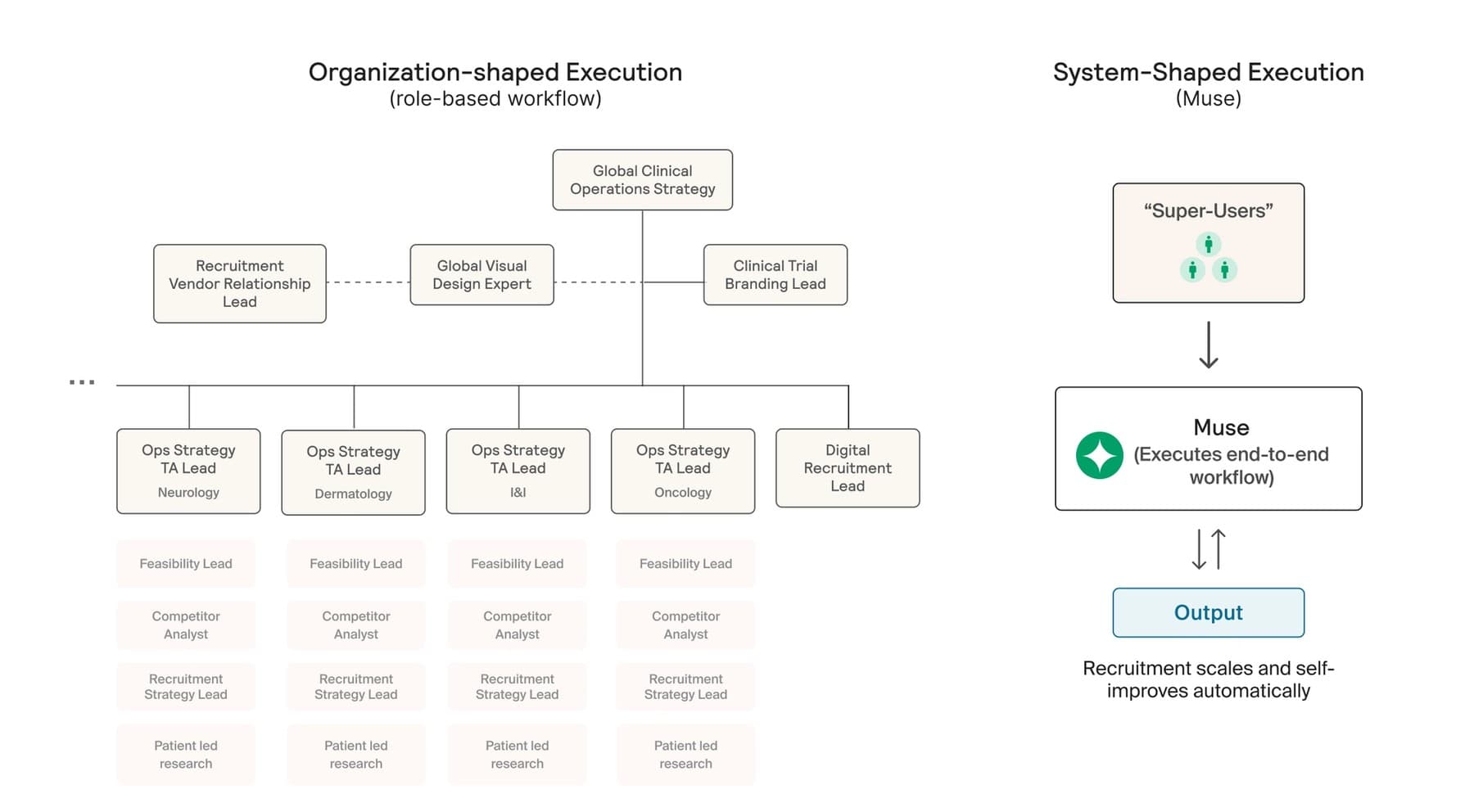
An AI-native company is one that has been re-architected so that whole workflows — the sort that today span six roles and four handoffs — are carried out by systems, with people placed at the points where judgment is genuinely required. The test is not how many people use a model. It is whether output can grow without headcount growing with it.
That distinction is the entire argument for why ribo.bio exists, so it is worth setting out properly.
Growth that does not scale with people
A small business grows by adding people and resources roughly in proportion to what it produces. A startup is a bet that technology breaks that proportionality. Software broke it for anything you can write down: rules, forms, thresholds, state machines. A handful of engineers can index the web, because indexing the web is one rule applied a trillion times.
But software only scales the reducible part of the work, the patterns you can specify in advance. Everything else stayed manual, and in drug development almost everything else is the work. A protocol amendment, a change order priced against a signed scope, a monitoring report that does not agree with the invoice attached to it: these are not edge cases at the margin of a codifiable process. They are the process.
Large models are the first tool that scales the irreducible part. Put plainly:
- Software scales reducible complexity, the patterns we can codify.
- AI scales irreducible complexity, the contexts nobody can enumerate in advance.
The unit of execution changes with it. It stops being a person holding a tool and becomes a system running inside guardrails, with an expert accountable for what comes out.
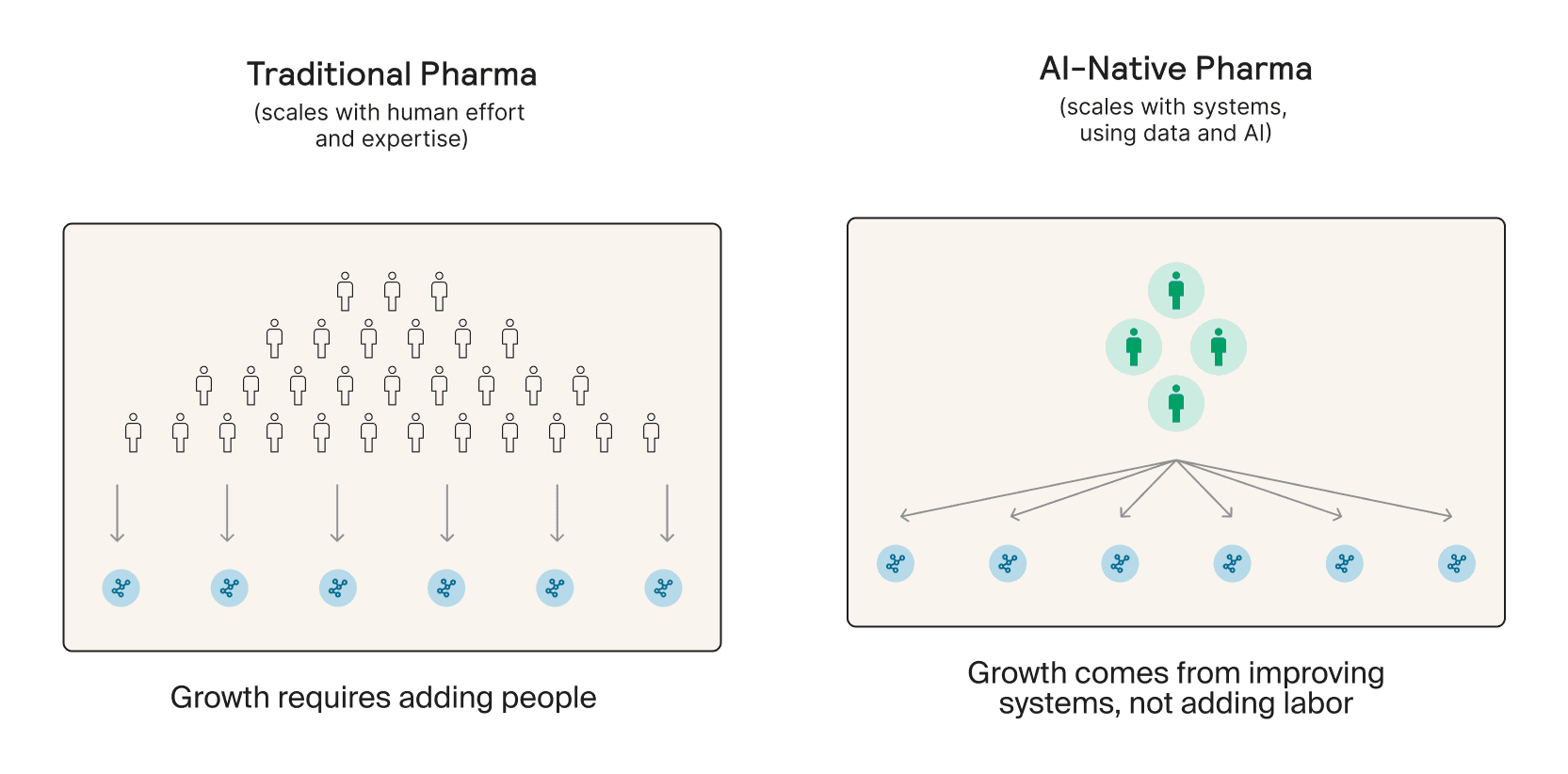
Sublinear scaling is the goal: an asset base that grows faster than the operating footprint behind it. Which raises the obvious question. If models are this good, why doesn’t handing every person in the current organisation an assistant get you there?
Conway’s law, and why point tools never move the number
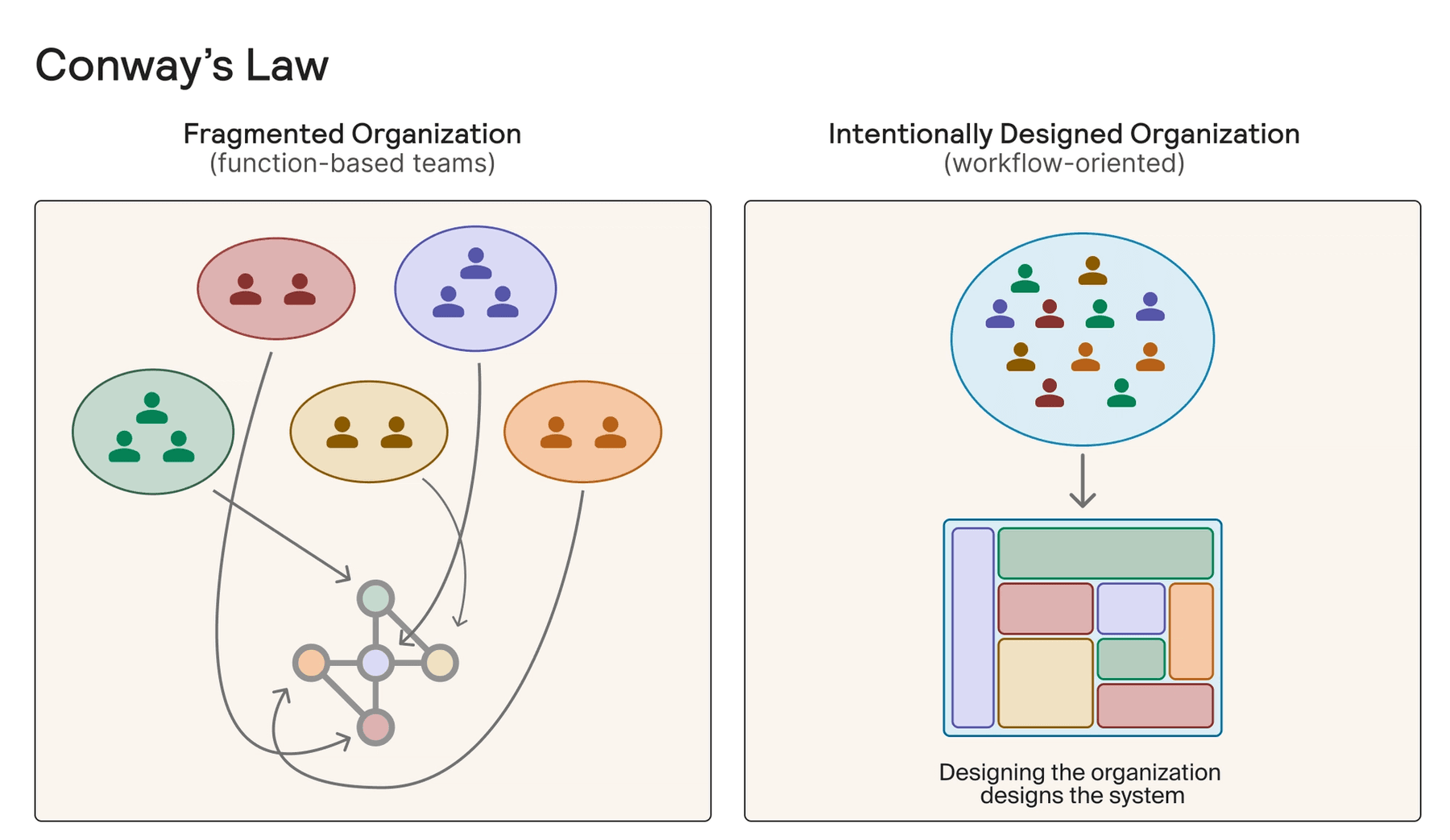
Conway’s law is the observation that an organisation ships products shaped like its own communication structure. Two teams, two experiences. A frontend team and a backend team, and friction exactly at the seam where they meet.
It can also be run in reverse: rather than letting the org chart dictate the system, design the org chart that would produce the system you want. Amazon wanted a fast-moving set of independent cloud services and built two-pizza teams to get them.
Now apply it to a biotech. Activating one trial site touches feasibility, contracting, budget negotiation, regulatory documents, site payments, vendor management, quality review and finance, and each of those is a different desk. Every desk is locally excellent. The cost is everything between them: the status meeting, the person on leave, the context that has to be re-explained, the document that is authoritative in one system and stale in another.
Give each of those desks a copilot and you have eight faster desks and the same eight handoffs. The fragmentation is structural, so the fix has to be structural too.
So the useful question is not “where could someone here use a model?” It is where does this work genuinely need human judgment, and can everything between those points be automated? Some of the checkpoints are load-bearing — patient safety, regulatory accountability, anything with a signature and a liability attached — and those stay exactly where they are. A surprising number of the rest exist because a job description needed a box.
Why almost nobody does this
Most companies are not incentivised to reorganise themselves around what systems can now do. Standing teams, entrenched expertise and years of local optimisation all pull the other way. Vendors cannot sell a product that requires a reorganisation to work, and buyers cannot get sign-off for a return that arrives in year three, so the market fills up with point solutions that ramp in a fortnight and cap out at ten per cent. The honest version is either built in from the beginning or arrived at through a painful transformation.
The prize is worth the difficulty. Call it operational alpha: not a percentage off a budget line, but a change in how the company scales. Twice the assets on a modestly larger team, and the marginal operating cost of the next programme heading toward zero. In an industry where the cost of a slow programme is counted in years of patients’ lives, that is not a margin story.
The tax nobody books
There is a second half to this, and it is the one that decides whether the first half holds. Come back from two weeks away and the morning goes on reconstruction: the threads, the comments, the three versions of one decision. Studies of knowledge work put the search for information a company already owns at twenty to thirty per cent of the week. More than a day, every week, spent on archaeology.
Engineers solved a version of this decades ago. They instrument. Requests are logged in enough detail to reconstruct what happened, errors route to the right team with the context attached, and flows can be traced end to end. It costs discipline and a few per cent of effort, and it is the only reason a production system can be debugged at all.
A company can be instrumented the same way: pay five per cent up front to capture context at the source instead of twenty per cent later to excavate it. In biotech the source material already exists. The contract, the protocol, the change order, the CRO’s monthly report and the mail thread that changed the scope are all sitting there. They are simply held as files rather than as facts.
Memory that appreciates
In most companies knowledge is a wasting asset. It begins losing value the moment it is created. At six months the document is hard to find, at a year the context around it has gone, at two years the person who held that context has moved on. Institutional amnesia is treated as a fact of life rather than as a choice.
Instrumented, the same knowledge compounds. Every piece of captured context is worth more later than it was on the day it was written, because it can be joined to things that had not happened yet.
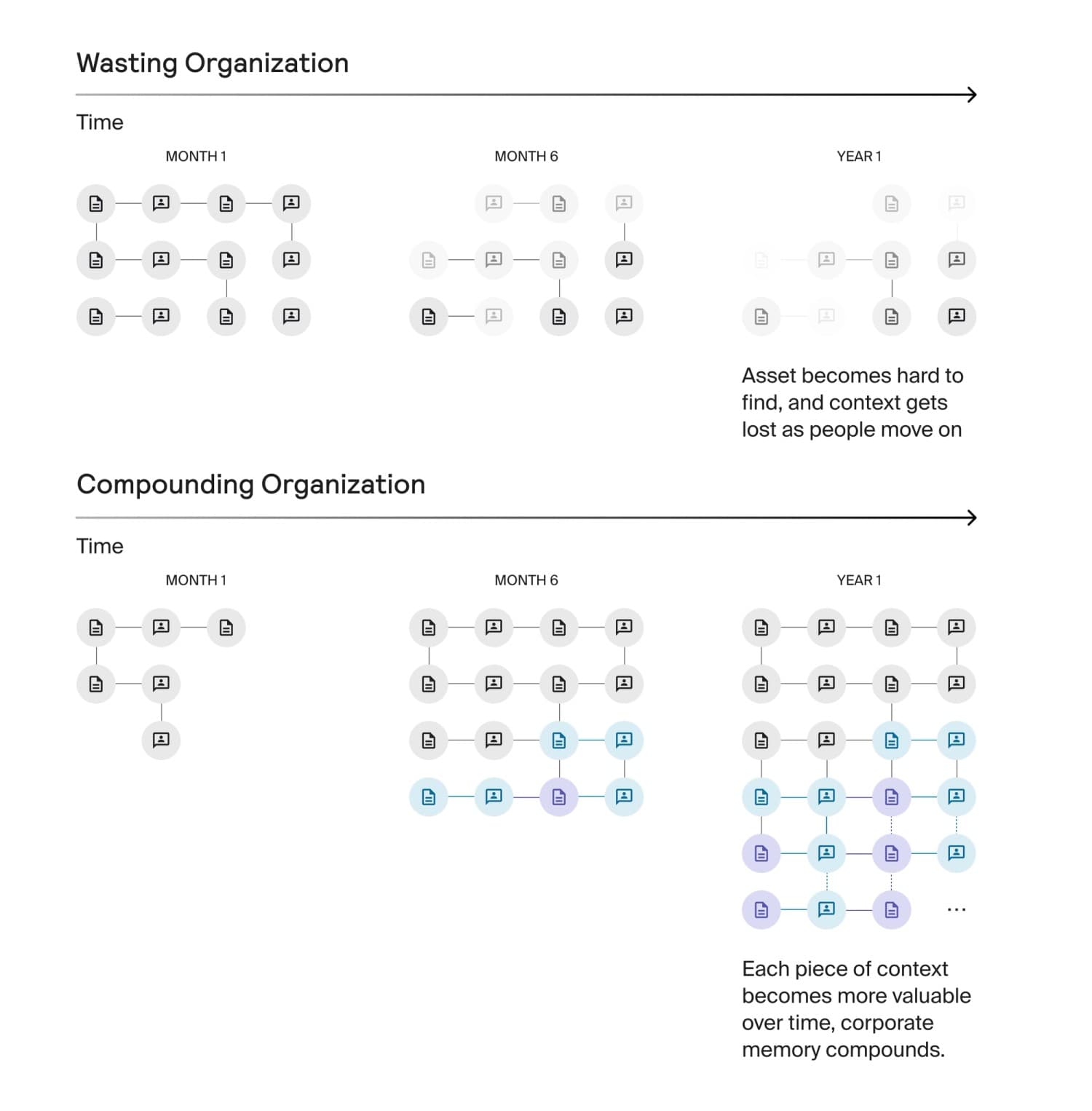
The returns are non-linear and back-loaded, which is why so few companies ever collect them. Month one feels like pure overhead. By month twelve there is a connected record of how every decision was reached. By year two, patterns are visible that no individual could have held in their head. By year three the system recalls the company better than its longest-serving employee.
One document, many uses
Why instrument so heavily? Because retrieval cost decides reuse. If finding an old analysis and rebuilding its context costs more than redoing the work, nobody reuses anything — and because everybody knows that in advance, nothing gets captured properly in the first place. It is a stable and expensive equilibrium.
Drop the cost of retrieval close to zero and it inverts. A single well-captured object starts serving uses that were not imagined when it was captured. Take one master services agreement with a CRO, read once and held as structured facts. It then:
- prices the change order that arrives eight months later against what was actually signed, rather than against what the vendor says was signed
- rebuilds the monthly accrual from evidence of delivery instead of from an estimate
- produces the audit trail when an inspector asks how a payment was approved
- sets the floor for the next negotiation with the same vendor
- answers a finance hire two years later who wants to know why that clause is written the way it is
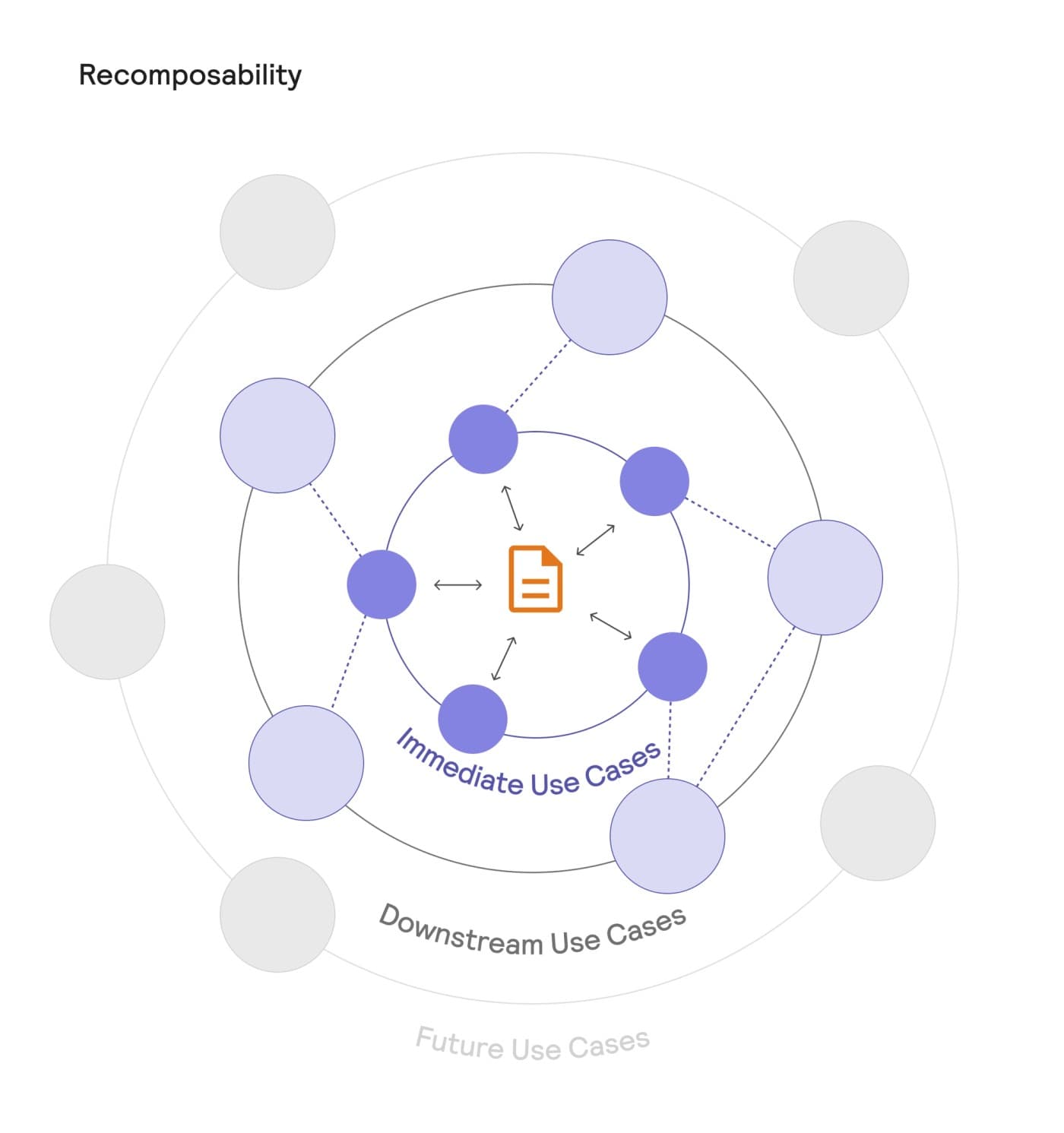
This only works small. In a fifty-thousand-person company spanning dozens of divisions, the coordination cost of making those connections swallows the benefit. In a thirty-person company working off one record, they happen by default. Conway’s law again, one level down: information architecture shapes decisions. If the information is siloed, so is the thinking.
A second seat at the table
Push this far enough and the organisation acquires something it did not have before: a reasoning system grounded in its own history, with total recall of it. Not a search box over a drive. Something that:
- surfaces, when an indication is proposed, that it was assessed two years ago, why it was deferred, and which of those reasons no longer hold
- answers a liability question by connecting a contract clause to a feasibility constraint and to an adverse-event pattern from an old trial — the risk that is only visible at the intersection
- argues against the decision you are about to make, using your own past reasoning, with perfect recall and no ego
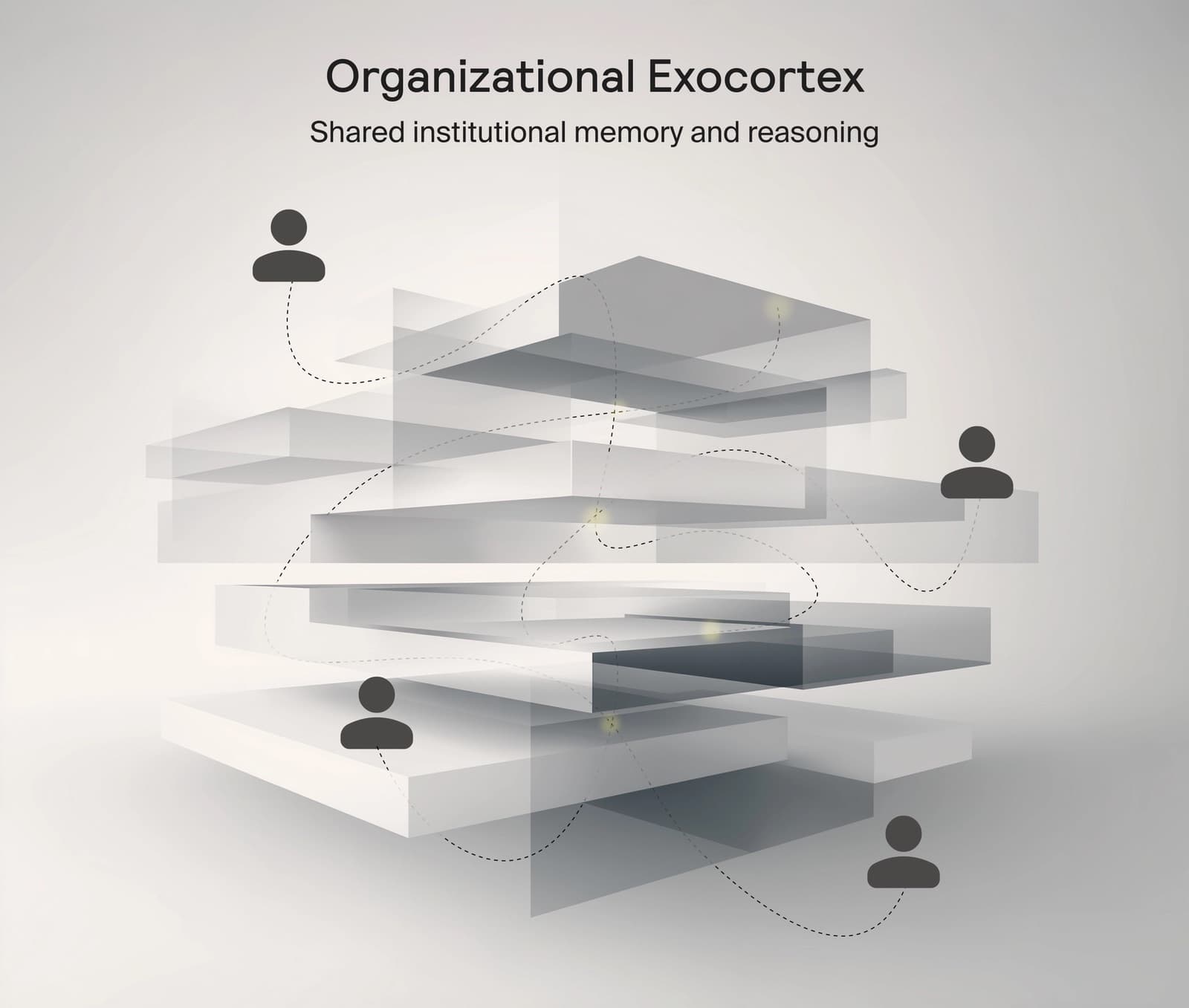
Within a few years it will look strange to write a development plan without asking a model that has read everything the company has ever done. It does not replace the experts. It is another seat at the table, with better recall than anyone else in the room.
Why this has to be built for you, not by you
The four pieces are one loop. Instrumentation captures the context that makes reuse possible. Reuse makes the systems good enough to justify redesigning the workflow. Redesign collapses the handoffs and delivers sublinear scaling. Sublinear scaling keeps the company small enough that instrumentation stays cheap. Miss one and the other three stall.
The usual conclusion drawn from that loop is that each company has to build the whole thing itself, from the ground up. For a company with a research platform, a balance sheet and a hundred engineers, that is right, and it is the correct thing for them to do.
It is not available to anybody else, and almost nobody else is who the next decade of medicine depends on. AI-driven discovery is lowering the cost of reaching a credible asset, which means far more sponsors, each much smaller: twenty people, one good molecule, no internal platform team and no reason to build one. Every one of them inherits the same administrative shell — the same contracts, accruals, filings, quality agreements and vendor mail — and today they carry it with people, because the alternative is a two-year engineering programme they cannot staff.
That gap is what ribo.bio is built for, and it is why the product is not a copilot bolted onto each existing seat. A copilot preserves the handoffs this whole piece has been arguing against. What a small company needs is the substrate: one record of itself, read from the contracts, invoices, protocols, filings and mail it already has; agents that carry the work between the checkpoints rather than assisting at each of them; and every action delivered with the document it came from, so a rebuilt accrual or a challenged invoice can be checked in a few seconds instead of trusted.
A twenty-person biotech should not have to become a software company to get compounding memory and sublinear scaling. It should be able to start with both on day one, and spend its people on the science.
If you are running finance or operations at a clinical-stage biotech, we would like to map what your week actually goes on, and show you what the agents can take over. You can book thirty minutes or write to hugo@first-ocean.com.
— Zenyi